
Last updated August 25, 2026
Free on-site gate assessment - hinges, posts, and your LiftMaster or Nice gate operator checked before anything is quoted
The assessment is free and the quote is the invoice.
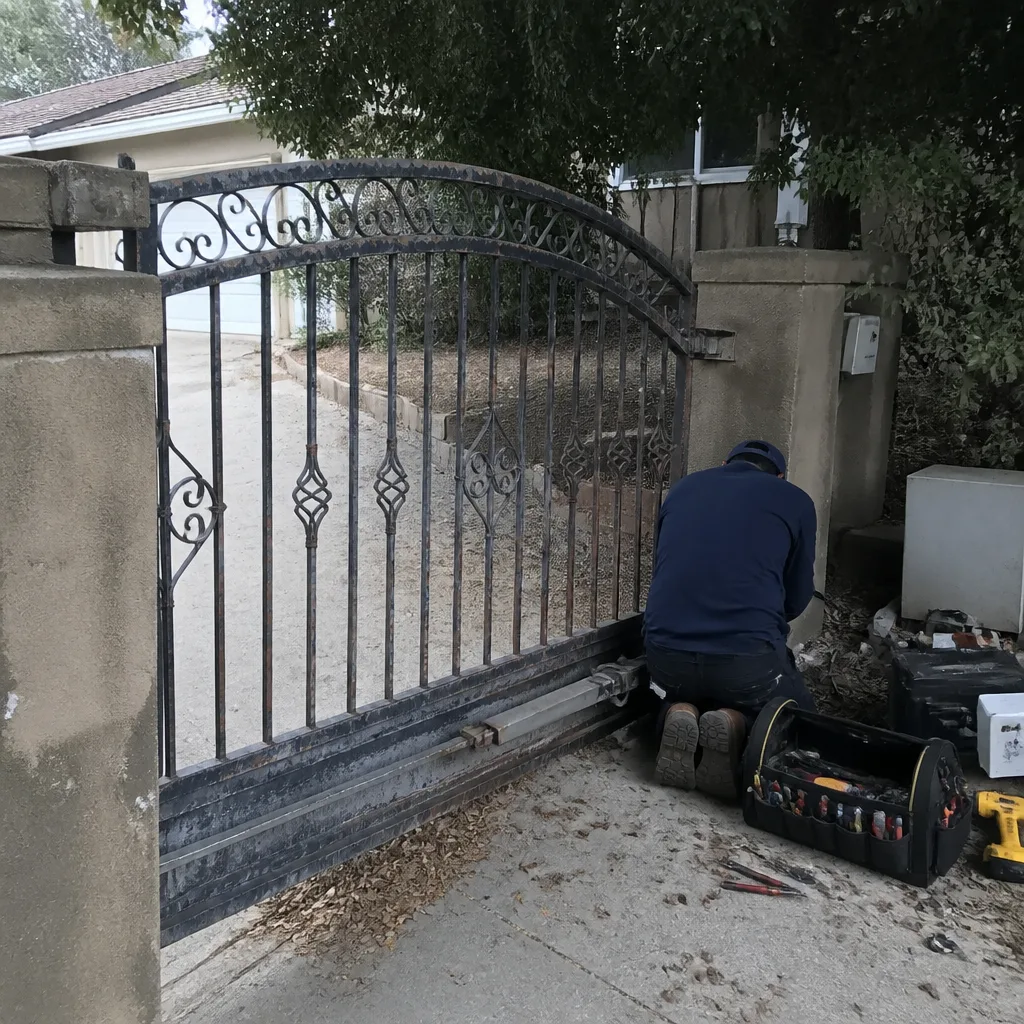 Before
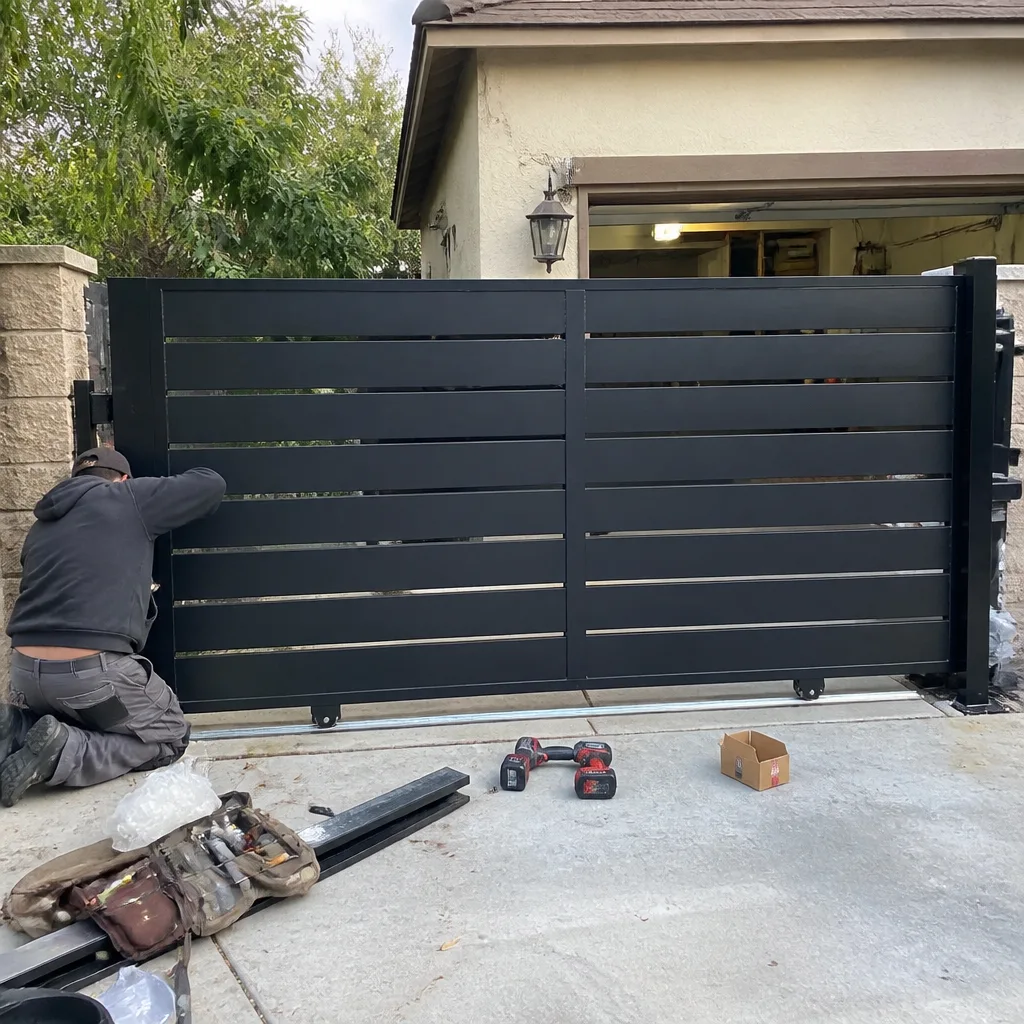 After
After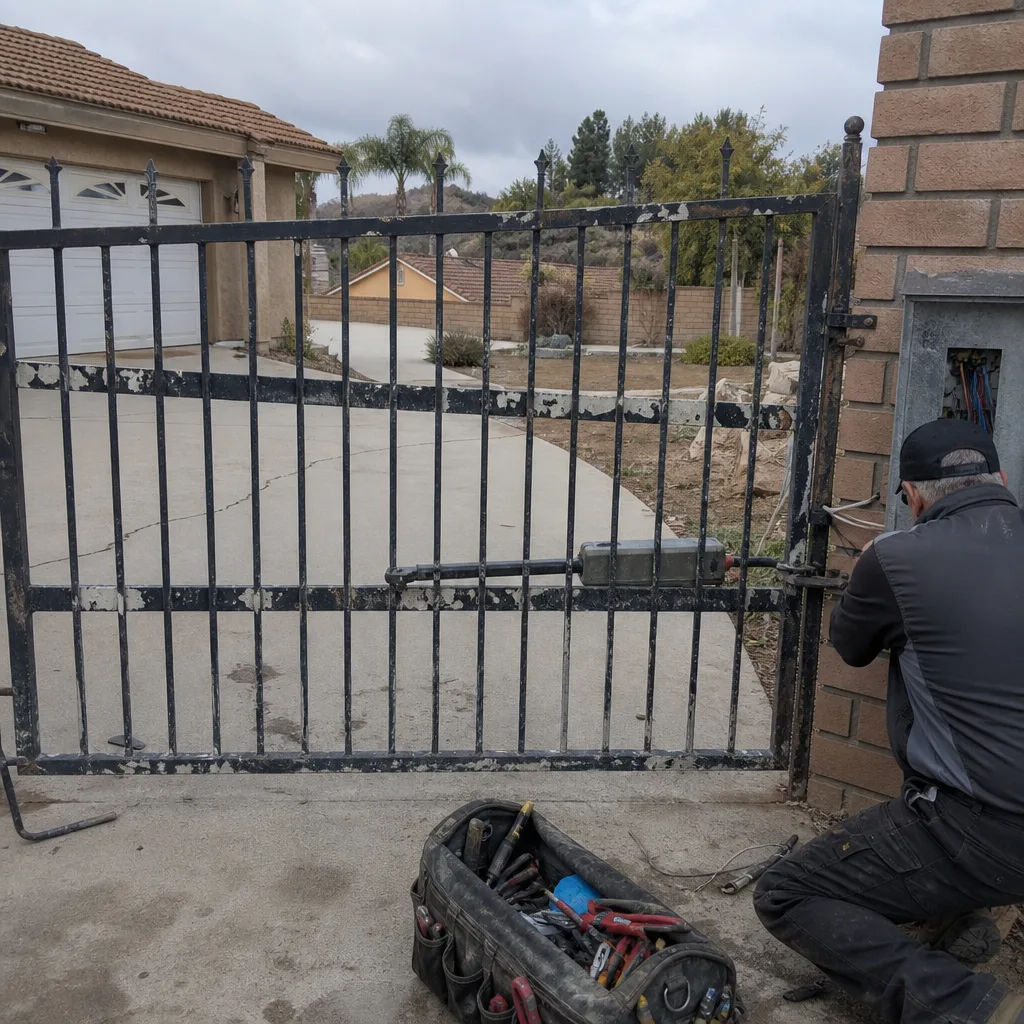 Before
 After
After Before
 After
AfterGate Repair Maintenance Checklist for Castaic Homeowners
The average Castaic driveway gate is the hardest-working appliance on your property, opening and closing somewhere between 1,500 and 3,000 times a year while taking direct hits from Santa Ana winds, triple-digit summer heat, and dust from the open hillsides. Yet most homeowners give it less attention than a kitchen faucet. A gate that gets a fifteen-minute seasonal inspection will typically outlast a neglected one by eight to ten years. This guide walks you through exactly what to check, when to check it, what you can safely handle yourself, and which problems mean a phone call today rather than tomorrow.
Quick Answer
A Castaic driveway gate needs a structured maintenance pass every three months: tighten and lubricate hinges, check the opener’s force settings and safety sensors, clear the track path of gravel and debris, and inspect for rust or sagging before it becomes a structural problem. Most homeowners can handle lubrication and debris clearing in under thirty minutes a season. Electrical diagnostics, spring adjustments, and any weld repair belong with a trained gate technician, because the stored tension in a gate spring and the force of a moving gate leaf can cause serious injury when mishandled.
Table of Contents
- The Seasonal Checkup That Prevents Most Castaic Gate Repairs
- How the Castaic Climate Ages Your Gate
- Hinges, Hardware, and the Telltale Signs of a Drooping Gate
- Gate Opener Maintenance for LiftMaster, DoorKing, and Elite Systems
- Safety Sensors, Photo Eyes, and the Force Settings You Should Never Disable
- Battery Backup, Keypads, and Access Control in a Castaic Power Outage
- What a Homeowner Can Safely Do Versus What Requires a Trained Technician
The Seasonal Checkup That Prevents Most Castaic Gate Repairs
The most expensive gate repair we perform in Castaic is almost always the one that started as a fifteen-dollar fix. A dry hinge wears its bushing, the gate drops a quarter inch, the opener strains against the added friction, and within six months the homeowner is replacing a control board or a gearbox instead of a hinge. The fix is a seasonal checkup, done four times a year, that takes less time than mowing the front lawn.
Here is the core maintenance pass we recommend for every Castaic property, whether your gate is a single swing arm, a double-leaf estate gate, or a rolling slide gate:
- Clear the path and the track. Gravel, eucalyptus leaves, and windblown debris from the hills accumulate in the track of a slide gate and under the swing arc of a swing gate. Remove everything. A single pebble wedged in a V-track can stall a 600-pound gate and burn out a motor.
- Lubricate the pivot points. Use a spray white lithium grease or a dedicated gate lubricant on hinge pins, ball bearings, and the opener’s drive chain or screw. Do not use WD-40 as a long-term lubricant – it cleans, but it dries out and leaves metal unprotected.
- Inspect for rust and bare metal. Castaic’s dry climate slows rust, but morning marine-layer moisture and irrigation overspray create localized corrosion. Touch up any bare steel with a rust-inhibiting paint or cold galvanizing spray before it pits.
- Test the opener’s force settings. A properly adjusted opener should stop and reverse if you push back against the gate leaf with moderate pressure. If it keeps pushing, the force limits are set too high, which is both a wear issue and a safety hazard.
- Check the safety sensors. Block the photo eye with your hand and press the remote. The gate should not move. If it does, stop using the gate immediately and call a technician.
In our experience, the homeowners in the Valencia and Castaic neighborhoods who keep a simple calendar reminder for March, June, September, and December are the same ones whose gates quietly last twenty years.
How the Castaic Climate Ages Your Gate
Castaic sits in a transitional zone where high-desert heat meets coastal influence, and the result is a specific set of gate problems you will not see in Santa Clarita or the San Fernando Valley. Daytime temperatures above 100 degrees are common from June through October, and the sun beats directly on metal gates with no shade relief from the open hillside lots that define much of the area. That heat does two things to a gate: it expands the metal, changing the geometry of a swing gate by a measurable fraction of an inch, and it bakes the electrolytic capacitors inside any opener control board that is mounted in a black metal box facing south or west.
The practical maintenance implications are straightforward:
- Control board placement matters. If your opener’s control box is mounted on the gate itself or on a post that gets full afternoon sun, it will fail years earlier than the same board mounted in shade. Where possible, we recommend relocating the control box to the shaded side of the post or installing a simple sun shield.
- Metal expansion changes latch alignment. If your gate latch sticks only on hot afternoons and works fine at night, the heat is the culprit. Adjusting the strike plate or latch position during a moderate-temperature day will usually solve the seasonal sticking.
- Dust is a lubricant killer. The dry hills around Castaic Lake and the open terrain off The Old Road generate fine dust that works its way into hinge pins and opener mechanisms. The dust mixes with grease to form an abrasive paste that accelerates wear. Wipe off old lubricant before applying fresh, rather than layering new over contaminated grease.
- Santa Ana winds stress welds. A gate leaf acts like a sail in a strong Santa Ana event. A 14-foot gate in a 50-mile-per-hour gust takes enormous lateral force, and the point of highest stress is always the weld where the gate frame meets the hinge side. Check those welds for hairline cracks after any major wind event, especially on older gates that predate current building standards.
The homeowners who get the most life from their Castaic gates are the ones who treat the climate as an active participant in the gate’s wear cycle, not a background detail.
Hinges, Hardware, and the Telltale Signs of a Drooping Gate
A driveway gate should sit level and swing or slide with even clearance from top to bottom. When a gate starts to droop, every component downstream pays for it: the opener motor strains, the latch misses its strike, the wheels on a slide gate wear unevenly, and the hinge bearings take a load they were never designed for. Catching a droop early is the single highest-value maintenance habit a Castaic homeowner can develop.
Here is what to look for, in order of how commonly we encounter it on gates in this area:
- The gate rubs the ground at the far end. On a double swing gate, the leaf farthest from the hinge post is the first to show droop. Look for scrape marks on the concrete, a worn path in the gravel, or a polished spot on the bottom rail.
- The latch no longer lines up. If you have to lift the gate leaf to get the latch to engage, the gate has dropped at least a quarter inch. That is the point where a hinge repair costs a few hundred dollars. Let it go another year and you are looking at replacing the hinge post or rebuilding the gate frame.
- The gate creaks or groans at one specific point in its arc. That sound is metal-on-metal contact, usually a dry pin or a failing bearing. Grease may quiet it temporarily, but if the sound returns within a few weeks, the bearing itself is worn out.
- The gap between the two gate leaves is uneven top to bottom. On a double gate, stand back and sight down the center line. If the gap at the top is wider than the gap at the bottom, one or both leaves have moved out of plane.
The takeaway is this: hinge and hardware problems are progressive. They never get better on their own, and they never stay the same size. A drooping gate is a clock running, and the sooner the clock is stopped, the smaller the bill.
Gate Opener Maintenance for LiftMaster, DoorKing, and Elite Systems
The opener is the component most Castaic homeowners think about least, until the morning it will not open and the car is stuck in the driveway. A little attention to the opener four times a year prevents the majority of those mornings. We service all nine major automation brands, but the three we see most often on Castaic properties are LiftMaster, DoorKing, and Elite, and each has its own maintenance personality.
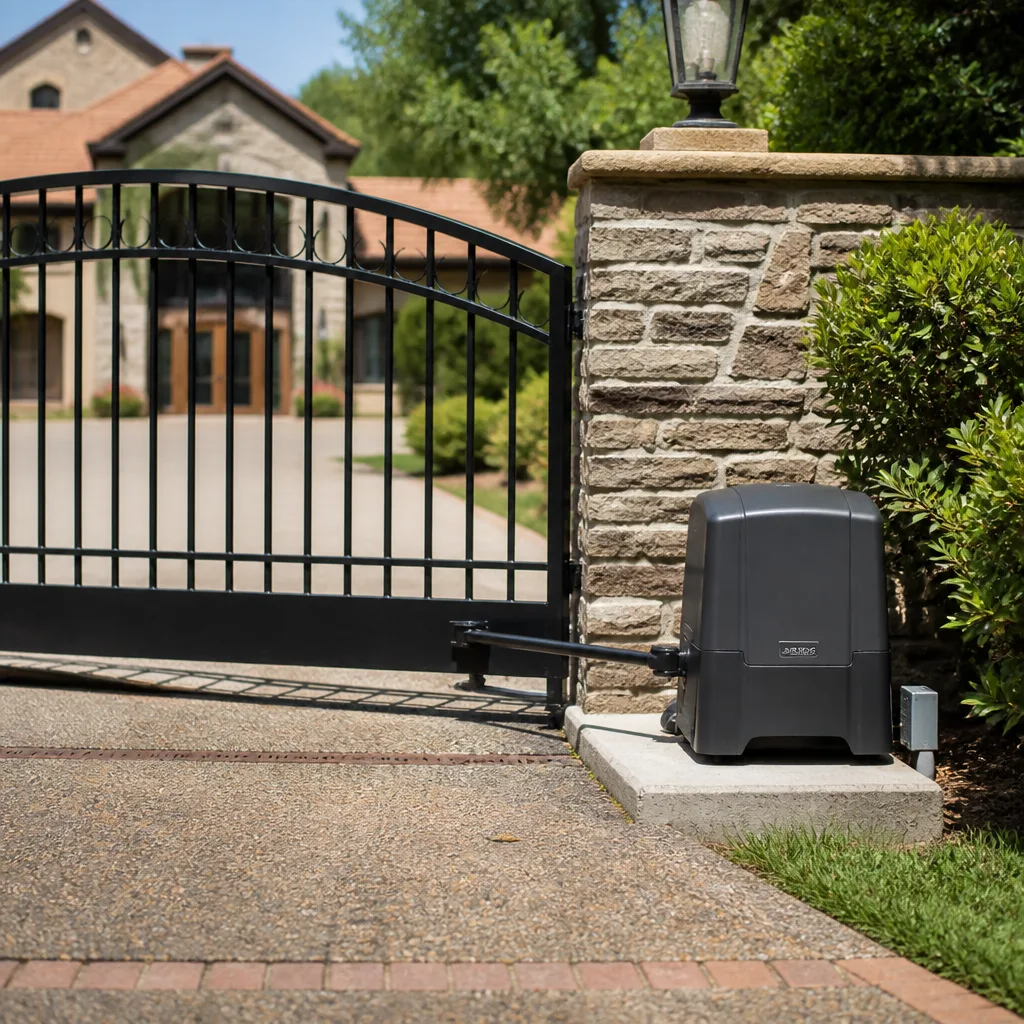
LiftMaster gate openers are common on residential swing gates, and they are generally reliable when the force settings stay within manufacturer spec. The two maintenance items that matter most are the belt or chain tension and the control board’s exposure to heat. Check the belt or chain for slack annually; a loose chain slaps the housing and a loose belt slips, both of which shorten component life. On the board, look for any plastic discoloration or a slightly sweet electrical smell, which is an early sign of capacitor failure from heat exposure.
DoorKing openers are the workhorses of the access-control world, found on everything from single-family driveway gates to small HOAs in the Castaic area. DoorKing units are overbuilt, but they take regular abuse because they are often installed on shared gates that cycle hundreds of times a day. The key maintenance item is the limit-switch adjustment: when a DoorKing gate starts to overtravel or stop short of the closed position, the limit switches need attention before the gearbox takes the shock. Also check the loop detectors if your gate has an exit loop in the driveway: a failing loop wire under broken concrete is a common DoorKing callout.
Elite gate openers appear frequently on estate properties and hilly Castaic lots where the gate runs on solar power or a battery bank. Elite systems are sensitive to voltage drop, so the maintenance focus is on the battery condition and the solar panel output. A battery more than three years old that has been through two Castaic summers is living on borrowed time. Test the battery voltage under load, not at rest; a battery can read 13.5 volts sitting idle and collapse to 9 volts the moment the opener draws current.
If you are not sure what brand is on your gate, the model plate is usually on the underside of the opener arm or inside the control box. Knowing the brand before you call a technician saves a service call, and it means the right parts are on the truck when someone shows up.
Safety Sensors, Photo Eyes, and the Force Settings You Should Never Disable
Every automated gate sold in the United States since the early 1990s is required by UL 325, the federal safety standard, to include a reversing mechanism that stops and reverses the gate when it encounters an obstruction. That mechanism comes in two forms: the photo eye, a pair of small lenses at knee height that detect anything breaking the beam, and the force limit, which measures resistance on the motor. Both are safety devices, and both are sometimes deliberately disabled by homeowners or handymen trying to stop a gate from reversing during windy weather or after a sensor alignment problem. That is a serious mistake, and here is why: a driveway gate moving at full speed can pin a child or a pet against a post with enough force to cause life-threatening injury. The safety features are not an inconvenience; they are the difference between a gate and a hazard.
- Keep both photo eye lenses clean. Dust from the Castaic hills coats the lenses quickly. A quick wipe with a dry cloth every month keeps the beam clean and prevents false reversals.
- Verify alignment after any bump. If a delivery truck clips a gate post, or a landscaper backs into the sensor, the photo eyes can shift out of alignment. Misaligned eyes cause the gate to refuse to close, which tempts someone to bypass them. Fix the alignment instead.
- Test the force reverse monthly. Place a rolled-up blanket or a sturdy cardboard box in the gate’s path and press the remote. The gate should stop and reverse within two seconds. If it plows through, the force setting is dangerously high.
- Never bypass a sensor to fix a symptom. If the gate will not close, and removing the sensor from the circuit makes it close, you have found a symptom, not a solution. The gate is now unsafe, and the underlying wiring or alignment problem still exists.
Safety sensor wiring is one of those jobs that looks simple and is not. A trained technician can repull a photo-eye wire and have the gate closing safely within an hour. A homeowner who jumps a sensor to get the gate closed has created a situation that can end in an emergency room. If you are not comfortable working with low-voltage wiring, do not open the control box.
Battery Backup, Keypads, and Access Control in a Castaic Power Outage
Castaic sits in a region where public-safety power shutoffs during fire season are part of life. When SCE cuts power to reduce wildfire risk, a gate opener on mains power becomes a dead bolt on your driveway unless you have a working manual release and you know how to use it. Many Castaic homeowners discover the manual release process for the first time in the dark, during a shutoff, with no power to the gate and a car stuck behind it. That is the wrong time to learn.
Here is what to prepare and check before the next outage:
- Know your manual release. Every opener has a mechanical release, usually a lever on the opener arm or a keyed release on the gate itself. Practice operating it twice a year, in daylight, so you can do it in the dark with a flashlight.
- Test your battery backup. If your opener has a battery backup module, run the gate on battery power for one full open-close cycle twice a year. If the gate slows noticeably or stops mid-cycle, the battery is done.
- Check keypad function monthly. Wired and wireless keypads fail gradually. Buttons get sticky, faces crack from UV exposure, and the code memory corrupts. If any keypad on your property takes more than one press to register, replace it now, not during the outage.
- Keep a physical key accessible. Many gates with a keyed lock have not had that lock used in years, and the cylinder is frozen with dust and corrosion. Lubricate the lock cylinder with a graphite spray annually and make sure the key is on a hook inside the house, not lost in a kitchen drawer.
Access-control systems on Castaic properties run the range from a simple four-digit keypad to full telephone-entry systems on estate gates. Whatever you have, the maintenance principle is the same: test it monthly, replace components before they fail rather than after, and treat every access device as part of the gate system, not an afterthought.
What a Homeowner Can Safely Do Versus What Requires a Trained Technician
There is a clear line between maintenance and repair, and knowing where it sits saves Castaic homeowners money without putting them at risk. Maintenance prevents problems. Repair fixes problems that already exist. The first is mostly within reach of a careful homeowner. The second often is not, because a driveway gate combines stored mechanical energy with electrical voltage in a way that punishes improvisation.
What a homeowner can safely do:
- Clear debris from the gate track and swing path
- Lubricate hinge pins and bearings with the proper grease
- Wipe down photo-eye lenses and check for obvious wire damage
- Test the safety reversal with a cardboard box
- Touch up surface rust with rust-inhibiting paint
- Test battery backup and practice the manual release
What requires a trained technician:
- Any work on the torsion spring, tension spring, or spring assembly
- Adjusting or replacing limit switches and force settings inside the control board
- Welding or structural repair of the gate frame, hinge post, or weld points
- Rewiring photo eyes, loop detectors, keypads, or any low-voltage circuit
- Replacing an opener gearbox, motor, or control board
- Straightening or rehanging a gate that has dropped out of plane
The reason professionals exist for this work is the same reason you do not remove your own appendix: the consequence of getting it wrong is far larger than the cost of getting it right. A gate spring under tension can release enough stored energy to break bone. An opener control board carries capacitor charge even after power is cut. Trained technicians know where the stored energy lives and how to release it safely. Homeowners who learn this the wrong way usually learn it in an ambulance.
In our experience, the smartest Castaic homeowners are the ones who do the maintenance pass themselves, take pride in it, and then call us the moment they find something outside their comfort zone. That is exactly how the system is supposed to work.
Common Mistakes to Avoid
- Using WD-40 as a permanent lubricant. WD-40 is a water displacer and cleaner, not a long-term grease. It evaporates within days and leaves hinges dry. Use white lithium grease or a dedicated gate lubricant.
- Ignoring a gate that gets slower every week. A progressively slower gate is a failing capacitor, a dying battery, or a gearbox running dry. It will not recover, and it will not stay the same. Slow is the warning light.
- Bypassing photo eyes to stop false reversals. This converts a safe gate into a dangerous one. Fix the alignment or the wiring; never disable the safety device.
- Adjusting force settings higher to push through a sticking gate. If the gate sticks, the gate has a mechanical problem. Crank up the force and the opener now has to muscle through the problem every cycle, which destroys the gearbox and removes the safety margin.
- Letting irrigation overspray hit the gate hinges or posts. Many Castaic lots have sprinklers near the driveway, and the overspray accelerates rust at the exact point of maximum stress. Adjust the sprinkler heads or move the drip line.
- Waiting until the gate will not open at all before calling. The most expensive repair we do is the one that started as a $200 fix and became a $2,000 replacement because the gate was run broken for a year. Early service calls are always cheaper than late ones.
- Hiring a handyman for a structural or electrical gate repair. A generalist who welds once a month and has never seen your opener brand is not the same as a technician who services that brand daily. The wrong fix is often more expensive than the right one would have been.
When to Call a Professional
Call a gate technician when you see any of the following: the gate rubs the ground or droops visibly, the opener makes a grinding or clicking sound, the gate reverses for no reason, the keypad or remote stops working, a weld shows a hairline crack, the gate moves slower than it did a month ago, or you see exposed wiring anywhere on the gate or post. Each of these is an early-stage problem that becomes an expensive problem if left alone. Ironworks Gate Co. offers free estimates in Castaic; call (350) 248-1180 and a live person will answer, any time of day or night. Ironworks Gate Co. home.
Frequently Asked Questions
Run a basic maintenance pass every three months, and do a more thorough inspection twice a year, in spring and fall. Quarterly maintenance prevents most failures; the twice-yearly deep check catches the slow-developing problems like hinge wear and battery degradation before they strand you.
The most common heat-related failure we see is a burned-out capacitor or transformer on a control board that sits in direct afternoon sun, especially on south- and west-facing posts. Relocating the control box to shade or adding a simple sun shield can add years to the opener’s life.
No. A sagging gate is almost always a structural issue: a worn hinge bearing, a bent hinge pin, or a frame that has settled out of square. Tightening the bolts does not address the underlying wear, and the gate will continue to drop until the hinge or the post fails.
High winds press against the gate leaf and increase the load on the opener, which the force sensors read as an obstruction. The correct fix is usually a combination of force setting adjustment, a wind brace modification for the gate, or a rebuilt hinge assembly that reduces friction. Do not raise the force limit to overpower the wind; that removes the safety margin the gate needs on calm days.
A seasonal inspection and lubrication runs about $89 with our seasonal tune-up offer, and it catches most problems before they become repairs. A gearbox replacement runs several hundred dollars; a full opener replacement runs more. Maintenance is the cheapest gate work you will ever buy.
Yes. Our technicians are trained and equipped on nine gate-automation brands: LiftMaster, DoorKing, Elite, Mighty Mule, FAAC, BFT, Linear, Viking, and Ghost Controls. Whatever is on your Castaic driveway, the correct fix is available on the first visit, not a week later after a part is ordered.
The Bottom Line
A Castaic driveway gate will last twenty years or more if it gets the right care, and the care is not complicated. Clear the path, lubricate the pivots, test the safety devices, respect the heat and wind and dust, and call a professional the moment something moves, sounds, or looks wrong. The homeowners who follow this checklist are the ones whose gates fail when they are predictable and old, not when they are sudden and inconvenient. Ironworks Gate Co. has been serving homeowners in this area for over 42 years, and we would rather keep your gate running than repair it. If this guide raised a question about your own gate, call (350) 248-1180 for a free estimate, any time of day or night.
Written by Victor Salinas, Owner at Ironworks Gate Co., serving Castaic since 2013.