
Last updated August 25, 2026
Free on-site gate assessment - hinges, posts, and your LiftMaster or Nice gate operator checked before anything is quoted
The assessment is free and the quote is the invoice.
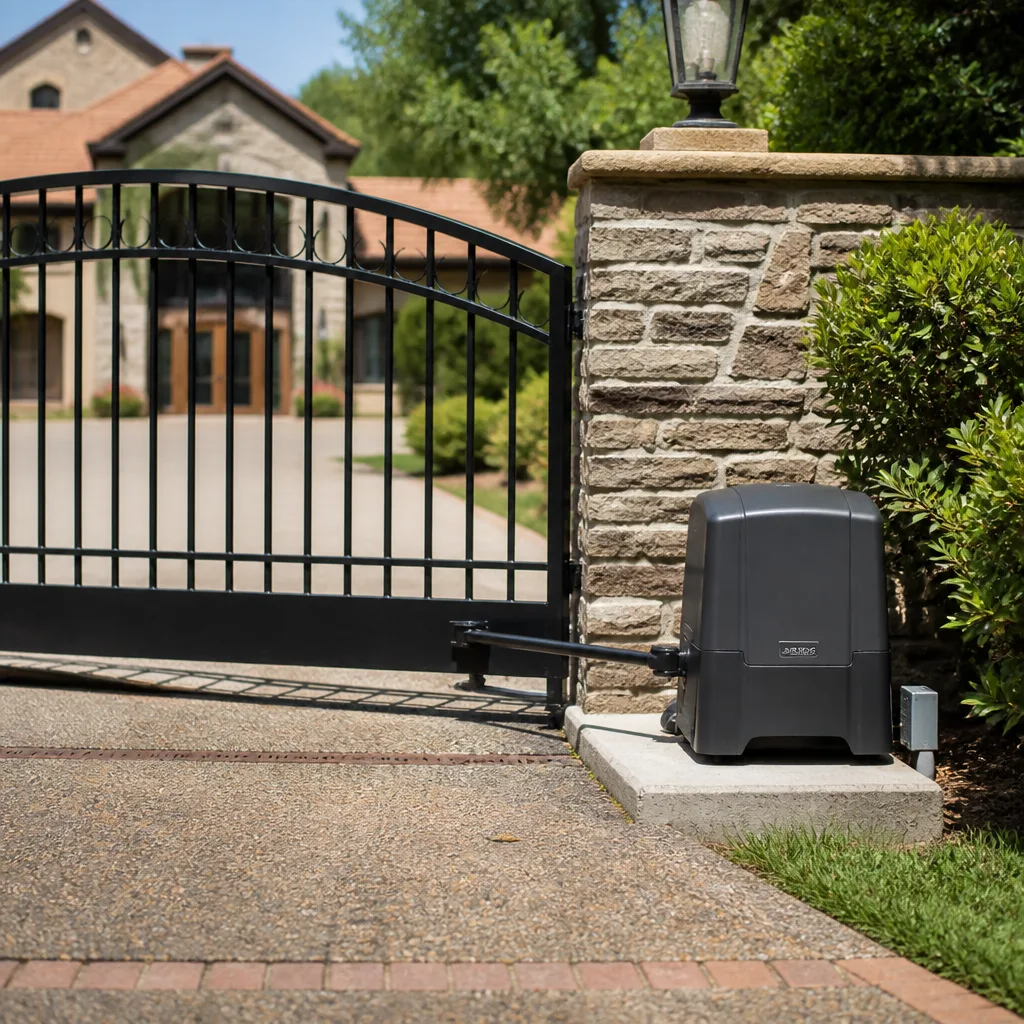
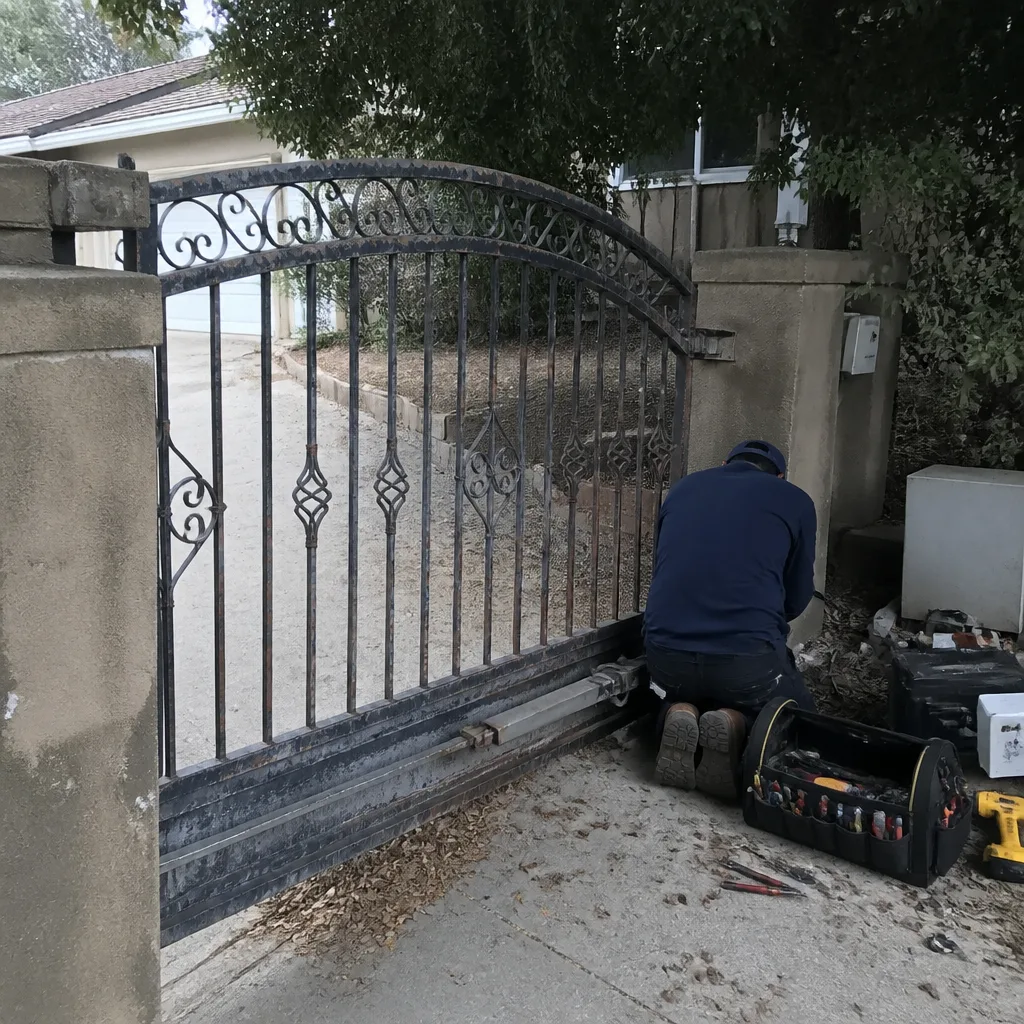 Before
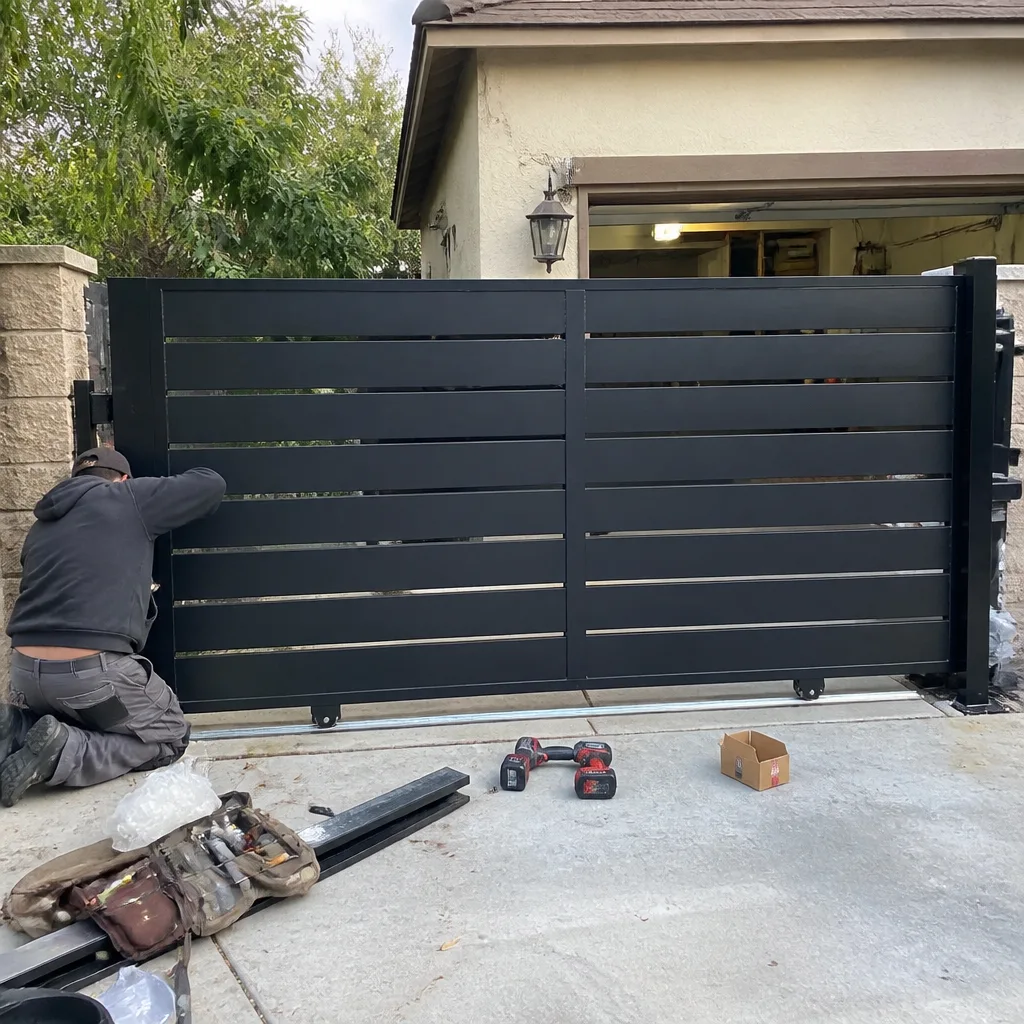 After
After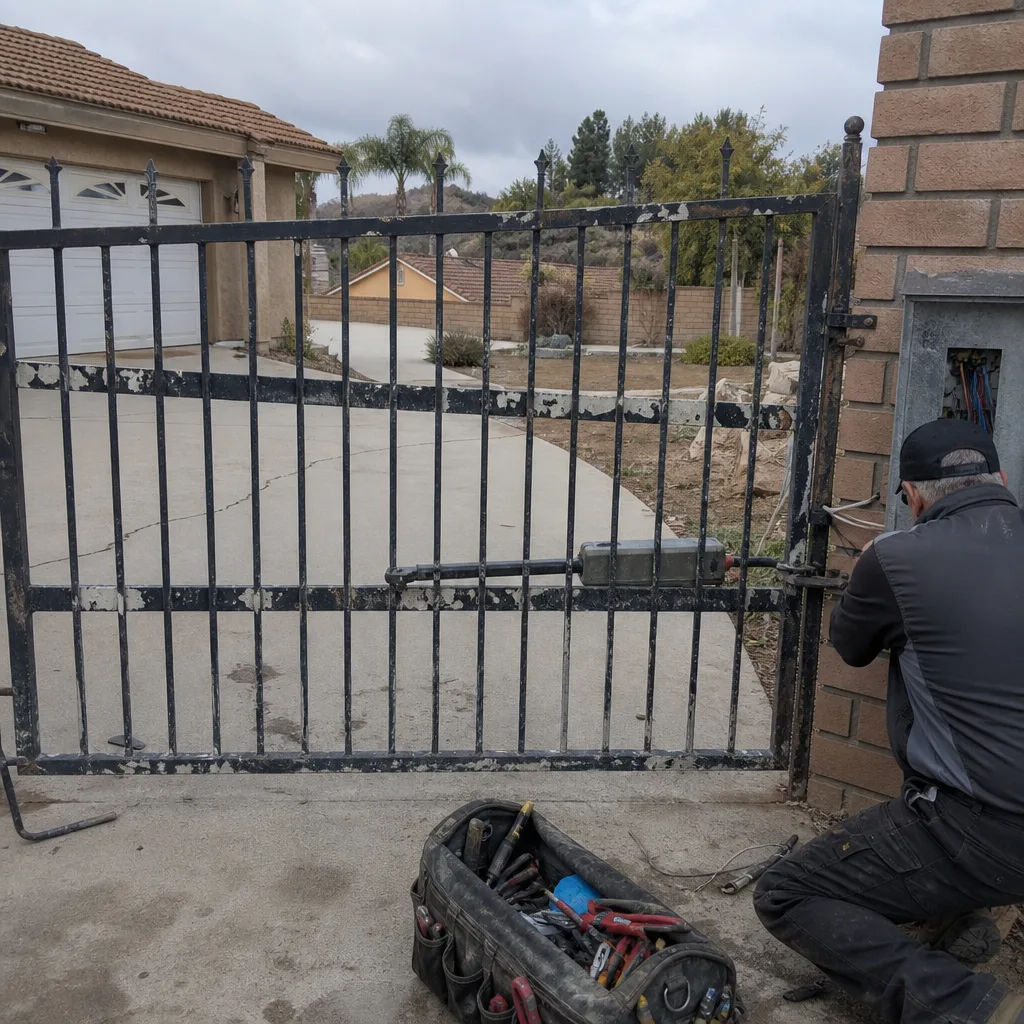 Before
 After
After Before
 After
AfterGate Repair Permits, Codes & Inspections in CA: What You Need to Know
Most California homeowners assume a gate repair needs no more paperwork than a garage door spring. They are wrong about half the time. Whether you need a permit for gate work in this state depends less on the repair itself and more on what you are altering, where your property sits, and how the gate is powered. A hinge replacement on an existing swing gate in Castaic rarely triggers a trip to the building department. Replacing the operator on a sliding driveway gate often does. This guide walks through the permits, California-specific codes, inspection rules, and real costs so you can plan the job without surprises.
Quick Answer
In California, most minor gate repairs - hinge replacement, wheel changes, weld fixes, keypad swaps - do not require a permit. Work that typically does require one includes new gate installations, structural post replacement, replacing or adding an automatic opener on a vehicle gate, and any electrical run longer than a few feet that feeds that opener. Inspections, when required, happen at rough-in and final stages, and the permit is pulled by the contractor or the homeowner, depending on the scope.
Table of Contents
- When a Gate Repair Needs a Permit in California
- California State Codes That Govern Gates and Gate Operators
- UL 325 and the Safety Rules Every Automatic Gate Must Follow
- The Inspection Process Step by Step
- What Permits and Inspections Actually Cost in Castaic
- Permit Responsibility: Homeowner vs. Contractor
- Entrapment Zones, Photo Eyes, and the Failure Points Inspectors Check
- Common Mistakes to Avoid
- When to Call a Professional
- Frequently Asked Questions
- The Bottom Line
When a Gate Repair Needs a Permit in California
The short answer: most repairs that restore an existing gate to its original working condition do not need a permit. The California Building Code (CBC) draws the line at alterations that change a structure’s size, weight, electrical load, or means of operation. Swapping a worn hinge for the same size hinge is maintenance. Adding a 300-pound steel overlay to an existing gate is an alteration, and that is where the building department gets interested.
Here is the working list we use in Castaic when a homeowner asks whether to pull a permit:
- No permit needed: hinge and bracket replacement, wheel and track replacement, gate leaf rebalancing, weld repair to existing steel, keypad or transmitter replacement, photocell sensor replacement, opener battery replacement.
- Permit generally required: installing a brand-new gate, replacing gate posts set in concrete, converting a manual gate to an automatic gate, replacing an automatic opener with a different model or voltage, running new electrical conduit to a gate, adding a pedestrian gate to an existing driveway gate system.
- Gray zone, varies by city: replacing an automatic opener with the same model and same electrical draw, raising the height of an existing gate, adding ornamental steelwork that changes gate weight significantly.
Castaic sits in unincorporated Los Angeles County, which means the Los Angeles County Building and Safety Division governs permit questions here, not a city hall permit counter. We have seen county inspectors apply the same standard as neighboring Santa Clarita but with a more deliberate review process on gate operator permits because of the county’s standardized safety checklist. The rule of thumb: if electricity touches the gate and it is not a like-for-like swap, plan on a permit.
California State Codes That Govern Gates and Gate Operators
California operates under the California Building Standards Code, known as Title 24. Gates fall under three main parts:
- CBC Chapter 3 (Building Planning): sets structural rules for gates, including required clearances, post footing depths, and wind load resistance. In Castaic, where Santa Ana winds can hit 60 miles per hour through the canyons, wind load calculations are not optional paperwork. An undersized post set in a shallow footing will fail in a wind event, and inspectors in this county know it.
- CEC (California Electrical Code): covers the wiring feeding gate operators, keypads, intercoms, and safety devices. Any new circuit or conduit run to a gate requires an electrical permit, and that work must be done by a licensed contractor or a homeowner who has pulled a homeowner-occupant electrical permit.
- UL 325 referenced standard: the California Code of Regulations incorporates UL 325 by reference as the governing standard for automatic gate operator safety. Not a code chapter, but a legally binding standard once referenced in code.
Beyond Title 24, two state-level rules matter in practice. First, the California Energy Commission’s Title 24 Part 6 applies only when a gate project includes new lighting or a new electrical circuit - most gate repairs do not trigger it. Second, the California Vehicle Code sections on private driveway entrances affect setback distances from public roads and sidewalk clearances. A sliding gate that opens across a public sidewalk requires a different review than a swing gate that opens inward.
In Castaic’s hill communities, homeowners on flag lots and private easements should know that LA County applies the same driveway setback rules regardless of whether the road is county-maintained. We have walked jobs where a gate moved eight feet from the road because the original was not permitted and sat inside the public right-of-way by six inches. The county will catch it during a permit review.
UL 325 and the Safety Rules Every Automatic Gate Must Follow
This section matters more than any other on this page. Automatic gates kill people, and that is why the code is written the way it is. Since January 2016, every new gate operator installed in the United States, including California, must comply with UL 325, the Standard for Safety for Door, Drapery, Gate, Louver, and Window Operators and Systems. The standard governs entrapment protection, warning signage, and operator function.
UL 325 divides gate operators into four classes:
- Class I: residential use only. The most common class for driveway gates on single-family properties in Castaic and surrounding areas.
- Class II: commercial or general public access, like a gated apartment complex or a store parking lot.
- Class III: industrial or limited-access spaces meant to restrain access, not used by the general public.
- Class IV: restricted access, like a prison or airport security gate. Rare in residential work.
The critical distinction for a homeowner: a Class I operator on a residential driveway has different entrapment protection requirements than a Class II operator. But every automatic gate - regardless of class - must have two independent means of entrapment protection, meaning two separate devices that each sense an obstruction and stop or reverse the gate. Typically that means a pair of photo eyes across the gate opening plus a reversing mechanism built into the operator that detects resistance.
One more hard rule: every automatic gate must carry two warning signs installed on the gate itself. Text must read “WARNING - Moving Gate Can Cause Serious Injury or Death” in letters at least one inch high. Markings must be visible from both sides of the gate. We replace missing warning stickers on nearly half the automatic gates we service in the Castaic area. Inspectors check for these before they check anything else.
The Inspection Process Step by Step
When a gate project does require a permit in unincorporated Los Angeles County, the process follows a predictable sequence. Here is the full flow, as we have watched it run dozens of times on Castaic properties:
- Permit application submitted. Either the contractor submits plans and the permit application electronically through the LA County Epic LA portal, or the homeowner does. For a new automatic gate, expect to provide a site plan showing the gate location, setbacks from the road and property lines, and the operator model and UL 325 compliance documentation.
- Plan review. The county checks the drawings against CBC Chapter 3 for structural adequacy and the CEC for electrical work. Typical turnaround in unincorporated LA County is two to four weeks. We tell Castaic homeowners to budget three weeks.
- Permit issued. Once approved, the county stamps the permit. Work cannot begin before this step. Starting early means the inspector can require you to expose completed work for inspection, which means digging up conduit or pulling off post caps.
- Rough-in inspection. After the gate posts are set in concrete and any electrical conduit is trenched but before concrete fully cures or backfill is placed, the inspector visits to check post depth, footing size, conduit burial depth, and grounding. In Castaic’s rocky soil, inspectors expect conduit buried at eighteen inches and posts set at least twenty-four inches deep, depending on gate weight and height.
- Final inspection. After the gate, operator, and safety devices are installed and functioning, the inspector returns to verify the gate operates within speed limits, entrapment protection devices work, warning signs are in place, and the gate reverses within the allowable force threshold.
On a repair-only job, none of this happens. Hinge replacement, wheel replacement, and weld repair on an existing gate are maintenance work, and the county does not want a permit application for them. The moment the job includes new electrical wire to the gate, count on at least two inspections.
What Permits and Inspections Actually Cost in Castaic
Permit costs in unincorporated Los Angeles County are based on a valuation table, not a flat fee. Here is what Castaic homeowners can expect for common gate projects:
- Automatic gate operator replacement permit (electrical): $180 to $320 in permit fees, depending on the valuation of the work.
- New driveway gate with new electrical: $350 to $700 in combined building and electrical permit fees.
- Plan review fee: typically 30 to 40 percent of the building permit fee, charged in addition.
- Re-inspection fee (if a required inspection fails): $90 to $150 per visit in LA County.
- Expedited plan review (if available): not routinely offered for residential gate projects in unincorporated areas.
These are county fees only. A contractor pulling the permit will typically include the permit cost in the proposal plus a markup of 10 to 15 percent for handling the paperwork, scheduling inspections, and meeting the inspector on site. In the Castaic area, that puts the all-in permitting cost for a typical automatic gate operator replacement between $400 and $600 on top of the labor and materials.
The real question is what skipping the permit costs. Performing unpermitted electrical work on a gate in California can bring a stop-work notice, a code enforcement citation, and, down the road, a disclosure problem when selling the home. Buyers notice unpermitted gate work on an inspection report. Sellers in Castaic have paid to have operators brought up to code after the fact more often than they anticipated.
Permit Responsibility: Homeowner vs. Contractor
In California, a licensed contractor who pulls a building permit for your project accepts legal responsibility for the work complying with code. A homeowner who pulls the permit personally, often called an owner-builder permit, accepts that responsibility themselves. The distinction matters because of liability and because of how the work gets inspected.
An owner-builder permit is legal in California and available for residential work. The rules: the homeowner must live in the home, the work must be for the homeowner’s own property, and the homeowner physically performs or directly supervises the work. You cannot pull an owner-builder permit and then hire an unlicensed handyman to do the work silently. If the county learns the work was performed by an unlicensed person under an owner-builder permit, the permit can be invalidated and the homeowner can face civil penalties.
When a licensed contractor pulls the permit, two practical benefits follow. First, the contractor’s license is on the line, so the contractor has a strong reason to meet code. Second, the contractor schedule inspections, meets the inspector on site, and handles correction notices without the homeowner taking time off work. In our experience, the homeowner-pulled permit on a gate operator job nearly always adds two or three weeks to the timeline because of schedule conflicts with inspection slots.
For anything involving electrical work on a gate operator in Castaic, the cleanest route is a state-licensed contractor pulling the permit. The electrical work feeding a gate operator is not a casual wiring job. Operators like LiftMaster and DoorKing units draw significant current at startup, and a poor connection, undersized conductor, or missing ground is a fire risk and a gate-failure point.
Entrapment Zones, Photo Eyes, and the Failure Points Inspectors Check
When an LA County inspector arrives for a gate final inspection, they work from a checklist. Understanding the checklist before the inspector arrives is the difference between passing first try and paying a re-inspection fee. The points they check, in order, are:
- Warning signs: two signs, one on each side of the gate, permanent, legible, one-inch minimum letter height. Missing signs are the most common automatic failure point.
- Photo eye placement: entrapment protection photo eyes must be positioned so the beam crosses the gate opening at no more than six inches above the ground, and their height must not allow a small child to crawl under the beam. On a sliding gate in Castaic, the photo eyes must be mounted on the gate itself and travel with it, or be positioned across the full opening including the area the gate slides into.
- Force settings: the operator’s reverse-on-contact force must be set so a reasonable adult can stop the gate’s motion without injury. The inspector will test this with a force gauge, not by asking whether it feels right.
- Travel limits: the gate must open fully without overrunning its stops and close fully against its stop, with the operator shutting off at both limits rather than straining.
- Grounding and bonding: the operator must be grounded per the CEC, and any metal gate frame must be bonded to the grounding conductor. A floating metal gate frame that is not bonded is a shock hazard when the operator energizes it.
- Secondary entrapment device: photo eyes are one device. The operator’s built-in reverse sensing is the second. The inspector will verify both function independently.
We see a specific failure pattern on Castaic hillside properties where gates are installed on slopes. The photo eyes get mounted at six inches above the high side of the grade, which leaves the low side with a gap under the beam large enough for a child to crawl through. The county flags it, and the fix involves regrading or repositioning, which is why we mention it before the inspector does.
Common Mistakes to Avoid
- Skipping the permit on an operator replacement. Replacing a gate operator with a different model, even if it is the same brand, changes the electrical characteristics and often requires a permit. Homeowners who skip it discover the issue when the home goes under contract and the buyer’s inspector flags the unpermitted electrical work.
- Moving a gate post without a structural review. The post carries the full weight of a swinging or sliding gate. Shortening it, moving it, or setting it in less concrete than the code requires leads to a gate that sags within two years. It also creates a failure point an inspector will catch if the work is ever reviewed.
- Ignoring entrapment protection. An automatic gate without functional photo eyes and reverse sensing is a life safety violation, not a minor defect. It also exposes the homeowner to liability if a child, pet, or visitor is injured.
- Buying an operator online and hiring a handyman to wire it. The handyman is not licensed for electrical work, the warranty on the operator is void without professional installation, and the finished job carries no permit. We have repaired these installs in Castaic, and the cost to make them right exceeds the original job.
- Not checking driveway setbacks before building a new gate. Gates set inside the public right-of-way or too close to the curb must be moved. In unincorporated LA County, the setback is measured from the edge of the road right-of-way, which is not the same as the edge of the paved road.
- Reusing old electrical when upgrading the operator. An old conduit run sized for a 1980s control box is rarely adequate for a modern LiftMaster or Elite operator. Overloaded circuits trip breakers and smoke operators, and the fix is re-trenching under a driveway, which is the expensive kind of fix.
- Hiding the permit work until after the fact. The county’s stop-work order and correction process is slower and more expensive than the permit would have been. We have never seen a Castaic homeowner save money by skipping the process.
When to Call a Professional
Three situations warrant a call before you touch the gate. First, any electrical work on a gate operator: the voltage and current available at a gate operator can cause serious injury or fire, and the code requirements around grounding and wiring methods are not intuitive. Second, any automatic gate that is not reversing correctly, is missing photo eyes, or has never had its force settings checked since installation: this is an entrapment hazard, and the fix is a calibration job, not a YouTube tutorial. Third, any structural work involving posts, footings, or gate weight changes: a gate that sags or fails is a multi-thousand-dollar repair, and the concrete and welding work is not incidental. Ironworks Gate Co. offers free estimates in Castaic for all gate work, from a hinge repair to a full operator replacement with permits handled. Call (350) 248-1180 and a live person answers, any hour, any day.
Frequently Asked Questions
Yes, with a narrow exception. Replacing a gate opener with the identical make and model and the same electrical draw may not require a permit, but replacing it with any different model, voltage, or amperage rating, or running any new electrical wiring, does. The permit is an electrical permit, not a building permit. Call (350) 248-1180 for a straight answer on your specific opener.
For most gate operator and electrical work in the Castaic area, county permit fees run between $180 and $700 total, depending on the project valuation, plus any contractor markup for permit handling and inspection attendance. The permit is quoted and agreed before any work begins. Call (350) 248-1180 for an exact quote.
Yes, an owner-builder permit is legally available to California homeowners who live in the home and will perform or directly supervise the work. In practice, most gate projects go smoother with a licensed contractor pulling the permit, because the contractor handles scheduling, meets the inspector, and carries the liability for code compliance.
The county can issue a stop-work notice and a code enforcement citation. More commonly, the issue surfaces when the home is sold and the buyer’s inspection flags the unpermitted work. Sellers then pay to bring the work to code after the fact, which often costs more than the original permit and inspection would have. Call (350) 248-1180 before you decide anything; the guidance is free.
A standalone manual gate that is replacing an existing manual gate of the same size and function generally does not need a permit. A new manual gate on new posts, or a manual gate that is taller, heavier, or set in new concrete footings, may require a building permit depending on the scope. In Castaic, the county’s test is whether the gate is new construction or a like-for-like replacement.
Most repairs, including hinge replacement, wheel replacement, weld repair, and keypad replacement, require no inspection. Work that does require a permit generally also requires at least a final inspection, and electrical work requires a rough-in inspection before the conduit is buried. The inspection timeline in unincorporated LA County is typically two to four weeks out from the permit date. Call (350) 248-1180 and we will tell you whether your job needs an inspection before you spend a dollar.
The Bottom Line
The permit question for gate work in California comes down to two simple tests. Is the job a like-for-like repair that restores what already exists? If yes, no permit, no inspection, no paperwork. Is the job adding something new - a new gate, new posts, new electrical, new automation? If yes, plan on a permit and at least one inspection. The codes exist because automatic gates have injured and killed people, and the safety requirements under UL 325 are the minimum standard, not a suggestion. In Castaic, the county enforces these rules steadily, and the cost of compliance is almost always less than the cost of compliance after the fact. Get a clear answer on your specific gate before you touch anything, and get it from someone who works on gates every day.
Written by Victor Salinas, Owner at Ironworks Gate Co., serving Castaic since 2013.