
Last updated August 25, 2026
Free on-site gate assessment - hinges, posts, and your LiftMaster or Nice gate operator checked before anything is quoted
The assessment is free and the quote is the invoice.
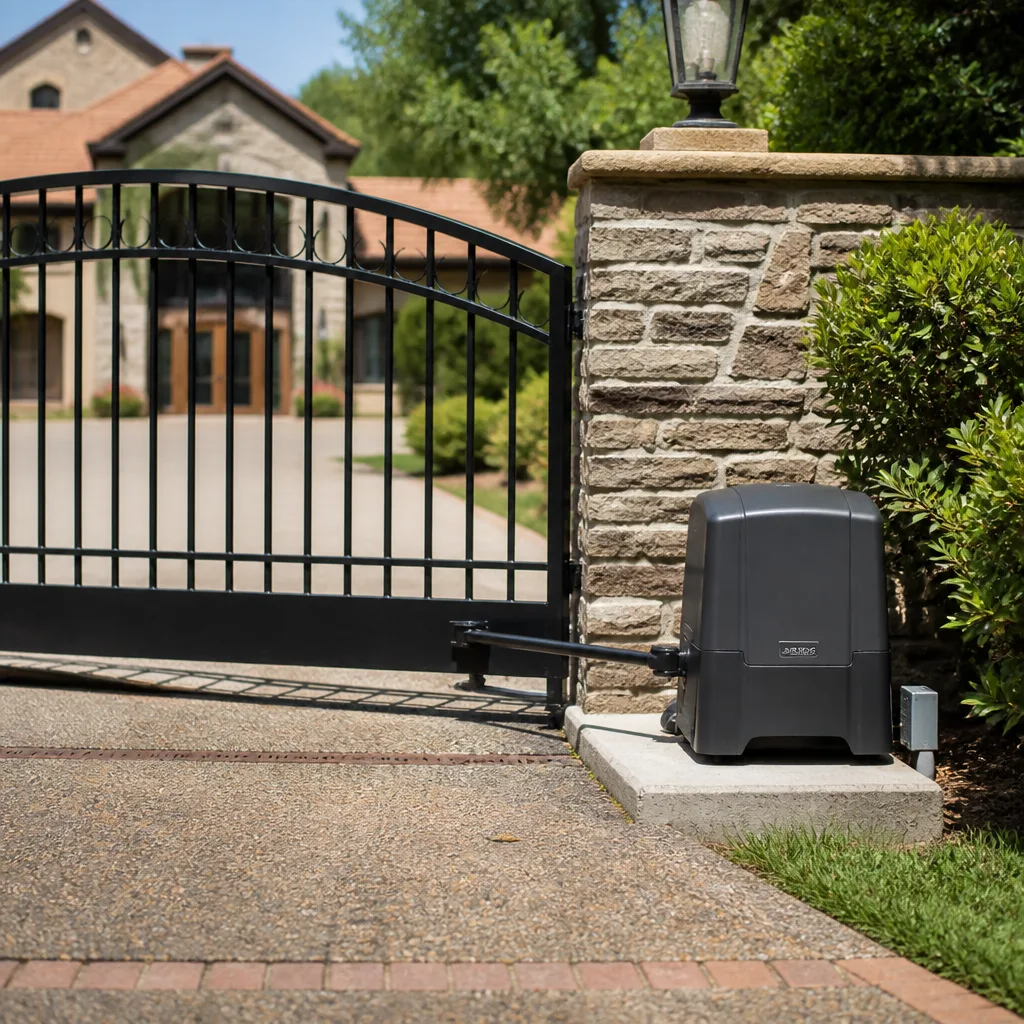
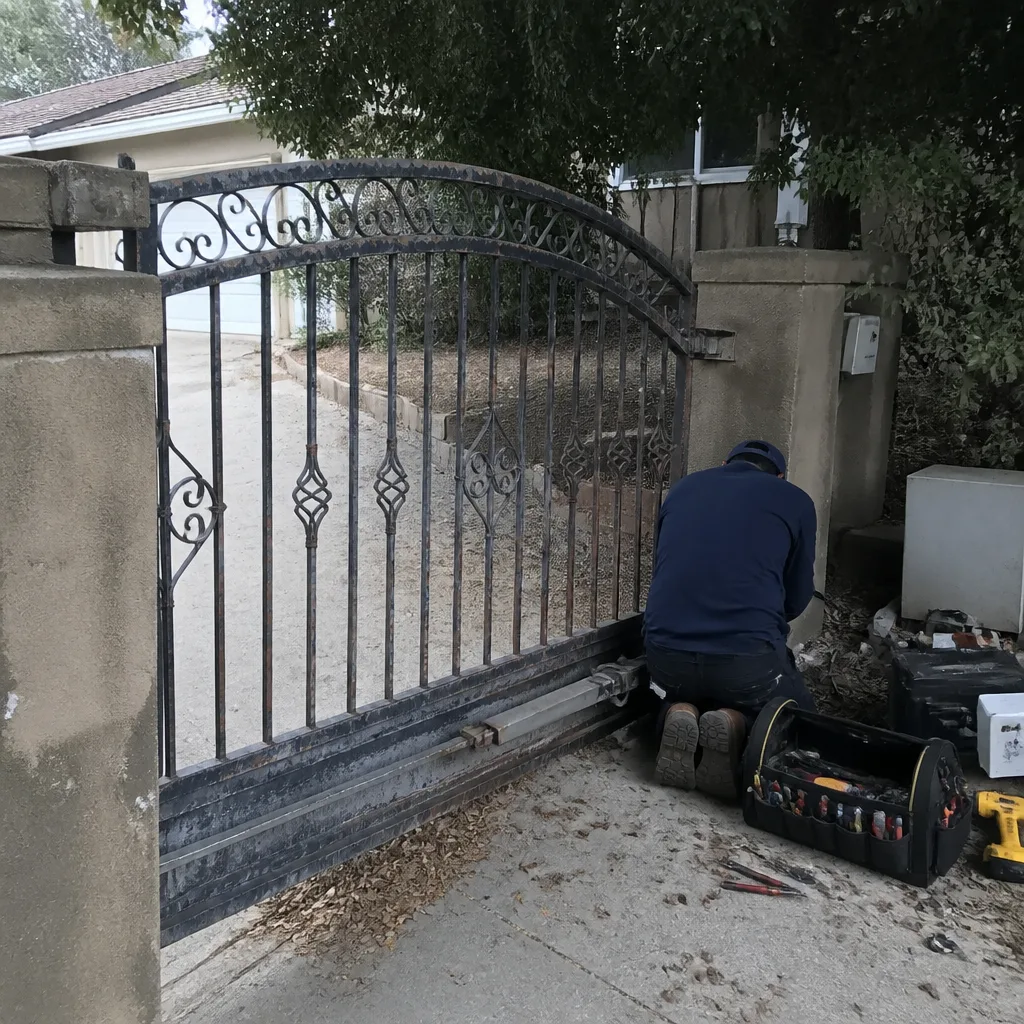 Before
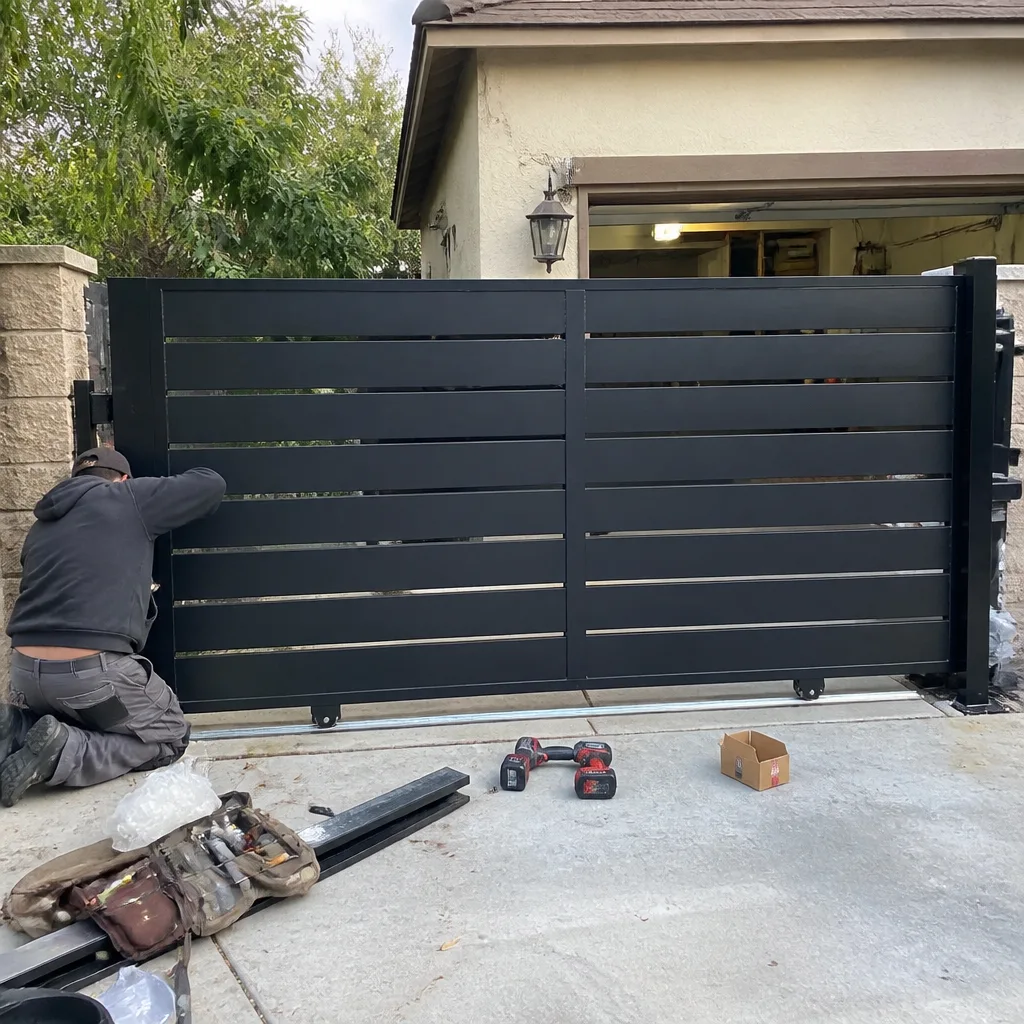 After
After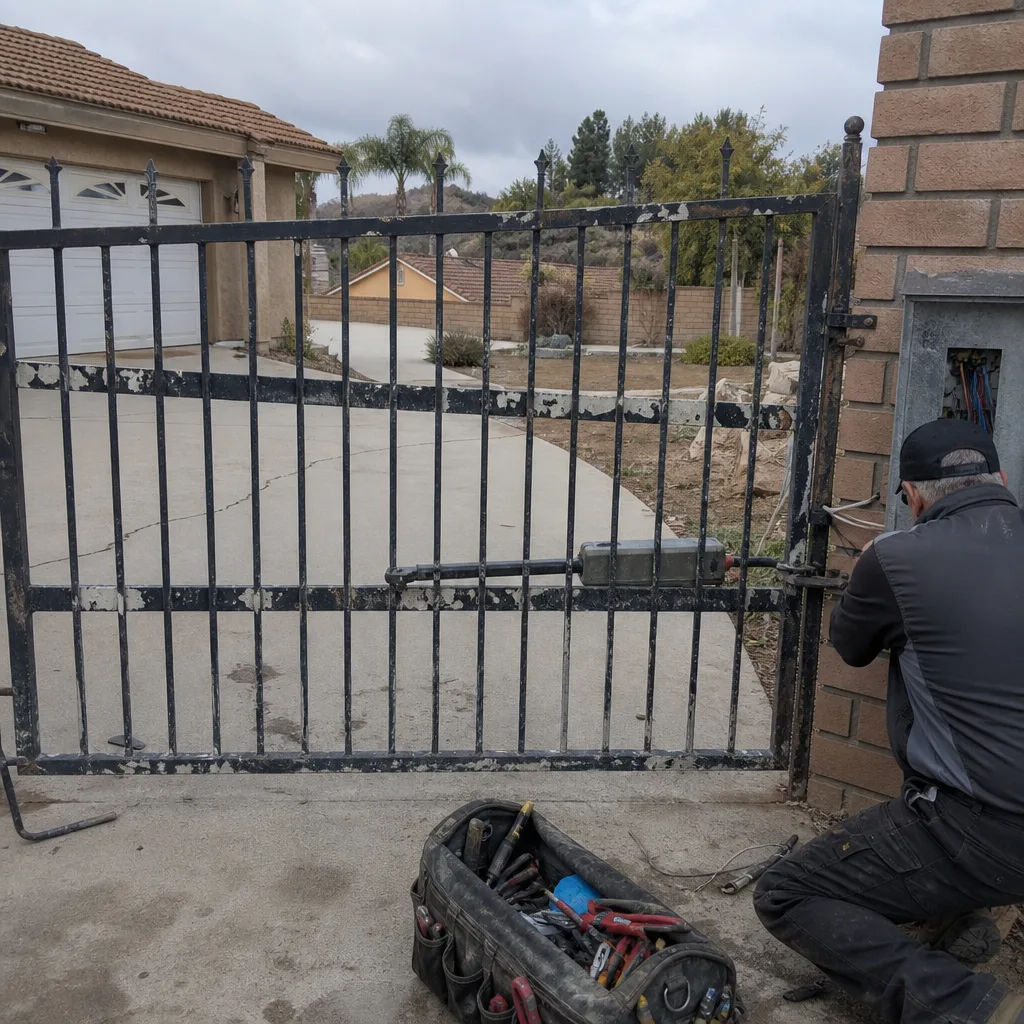 Before
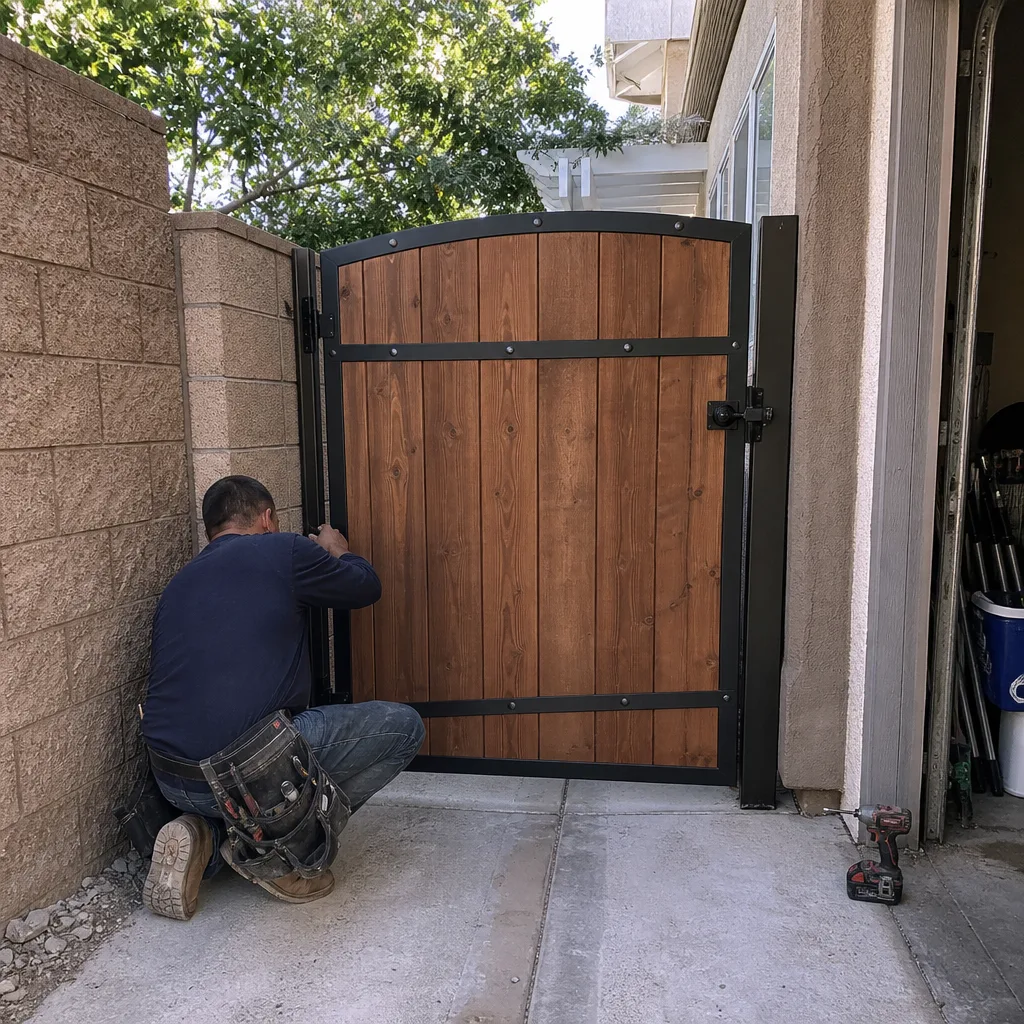 After
After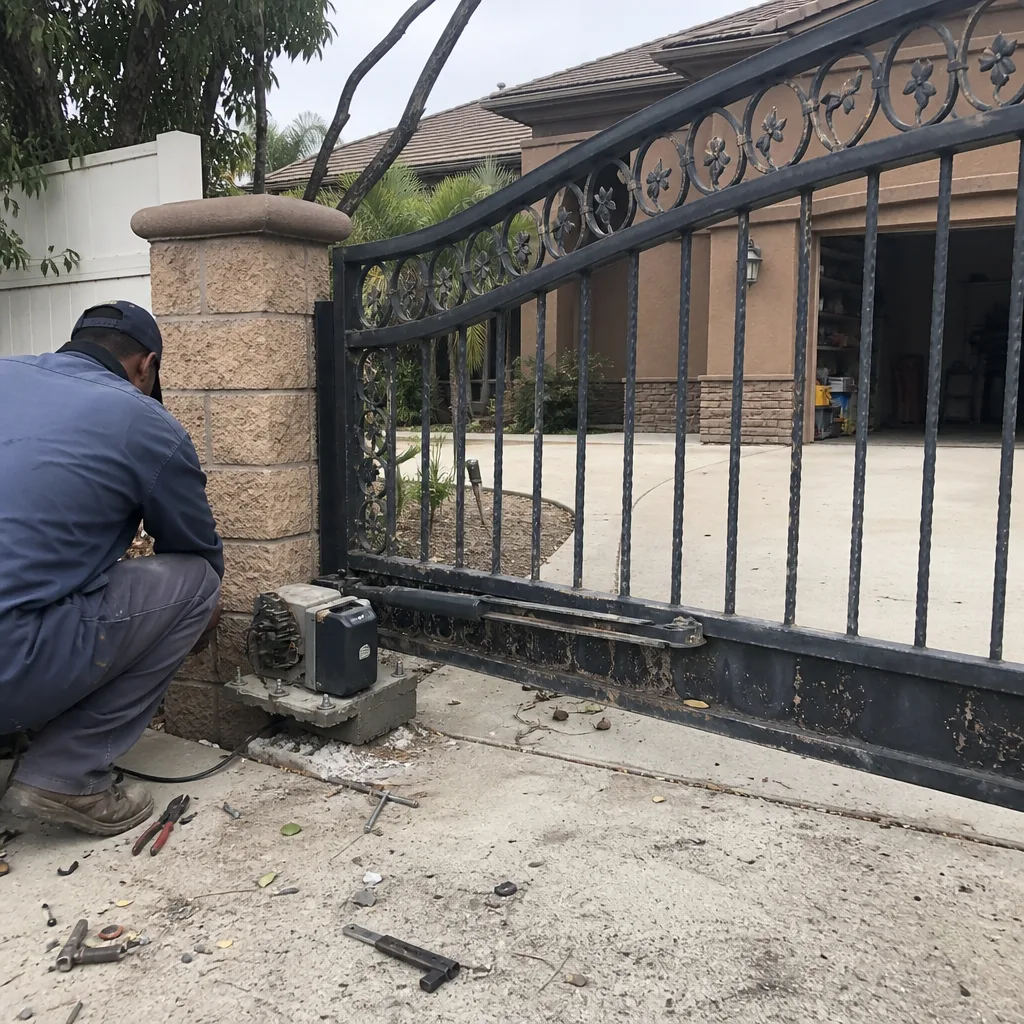 Before
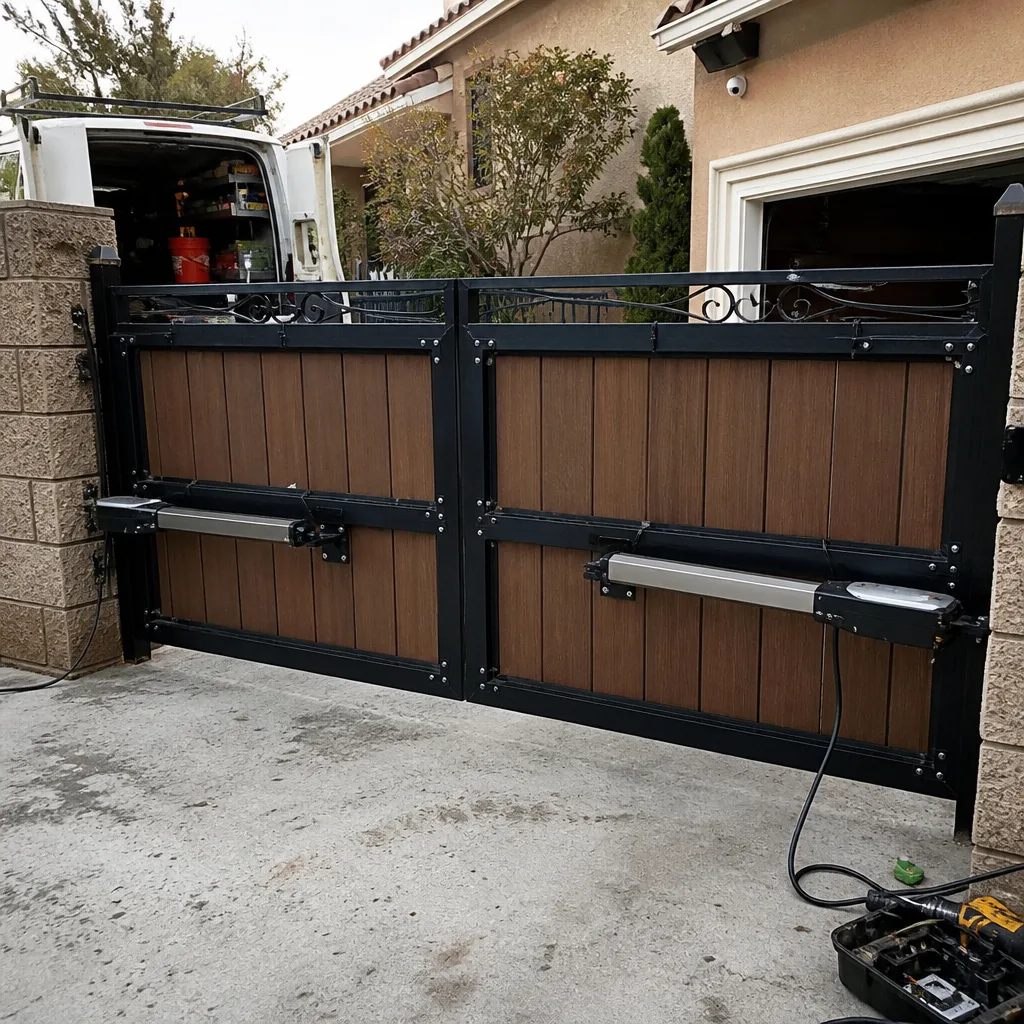 After
AfterSeasonal Gate Repair Care for Castaic: Year-Round Homeowner’s Guide
Most homeowners in Castaic don’t think about their driveway gate until the day it stops opening. That’s not a criticism. It’s just how gates work. They sit there, swinging or sliding on command for years, until the morning they don’t. What surprises people is that the failure almost never happens suddenly. It builds. A hinge stiffens through one Santa Ana season, a limit switch drifts out of adjustment over a cold snap, a gear wears down across three summers of 100-degree afternoons. By the time the gate fails, the damage has been compounding for months. This guide explains what actually wears on a gate in Castaic’s specific climate, what to check each season, what to leave alone, and when a repair is cheaper than a replacement. By the end, you’ll know more about your gate than most handymen do.
Quick Answer
Seasonal gate care in Castaic means checking hinges, tracks, and safety sensors before the hot, dry summer and after the wet, windy winter, and addressing small problems like stiff rollers or drifted open limits before they become motor-killing failures. Most homeowners can handle basic cleaning and visual inspection, but spring tension, motor programming, and welded repairs should always be left to a trained professional, especially on heavy estate gates.
Table of Contents
- Why Castaic Weather Is Harder on Gates Than You’d Think
- The Seasonal Inspection: What to Check, and When
- Steel, Iron, and the Castaic Sun: Preventing Metal Fatigue Before It Starts
- Gate Automation: The Electronics That Fail First in Heat and Dust
- Wind, Wildfire Season, and Why Your Gate’s Safety Edges Matter
- What a Professional Tune-Up Actually Includes (and What It Costs)
- Common Mistakes to Avoid
- When to Call a Professional
- Frequently Asked Questions
- The Bottom Line
Why Castaic Weather Is Harder on Gates Than You’d Think
Castaic sits in a climate that punishes moving metal parts. We’re not on the coast. We’re not in the high desert. We’re in that in-between zone where summer afternoons push past 100 degrees, winter mornings drop into the 30s, and the wind through the Grapevine corridor picks up enough dust to sandblast a gate over the course of a decade. That combination, heat plus cold plus abrasive dust plus low humidity, is what wears out gate hardware faster here than in Valencia or Stevenson Ranch.
The heat is the quiet killer. When a driveway gate sits in direct sun for eight hours, the steel expands. At night it contracts. Over years, that thermal cycling loosens bolts, opens hairline cracks in welds, and stresses the powder coating. The dust, carried on wind that funnels down from the Tejon Pass, works its way into rollers, tracks, and gearboxes. It mixes with the grease and becomes a grinding paste. We’ve pulled apart gate motors in Castaic where the internal gears looked like they’d been lapped with sandpaper. That’s not neglect. That’s just the local environment doing what it does.
The good news is that most of this damage is preventable with a simple seasonal routine. The bad news is that most homeowners don’t have one. By the time we get the call, a $40 roller replacement has become an $800 motor replacement. Understanding what to look for, and when, changes the math entirely.
The Seasonal Inspection: What to Check, and When
A gate inspection doesn’t need to be complicated. Twice a year is enough for most Castaic homes. Once in April, before the heat arrives. Once in November, after the first big wind and before the rainy season. Each inspection takes about 20 minutes and catches the problems that turn cheap fixes into expensive ones.
Here’s the step-by-step routine we recommend to every homeowner in Castaic:
- Stand at the closed gate and look at the top rail. It should be level. If one end sags even half an inch, the post or the hinge is starting to fail. Level is the first thing to go on a heavy gate.
- Open the gate by hand (if it’s manual) or in manual release mode (if it’s automated). Push it through its full arc. It should move smoothly, with no grinding, no catching, no place where you have to shove. Any resistance is a sign that a roller, hinge, or track has a problem.
- Look at the wheels or rollers. Spin them by hand if you can reach them. They should turn freely. Flat spots, wobble, or a gritty feel means they’re done.
- Check the gate’s resting position. A closed gate should sit flush against its stops, not resting on them at an angle. An open gate should hold its position without creeping.
- Walk the full length of the track (for slide gates). Pull out leaves, pine needles, gravel, and anything else that’s collected in the rail. A chunk of decomposed granite in the wrong place can bind a wheel and stall a motor.
- Test the safety sensors. Wave your hand in front of the photo eyes while the gate is moving. It should reverse immediately. If it doesn’t, the sensors are dirty, misaligned, or dead.
- Look for rust, cracks, or missing bolts. Spend two minutes walking the gate’s frame. Rust at a joint is the beginning of a structural problem. Rust at a hinge is the beginning of a big one.
Do this in April and November, and you’ll catch 80% of the problems we see on service calls before they become emergencies. The other 20% require a trained eye and the right tools. That’s why the Ironworks Gate Co. home page exists, and why we offer an $89 Seasonal Tune-Up for homeowners who’d rather not climb around a 400-pound gate on a Saturday morning.
Steel, Iron, and the Castaic Sun: Preventing Metal Fatigue Before It Starts
Your gate is a metal object. That sounds obvious, but most people forget what metal does over time. It flexes. It oxidizes. It fatigues. Every opening and closing cycle puts stress on the welds, the hinges, and the point where the gate connects to its post. A well-built gate can handle that stress for decades. A gate that’s been ignored will eventually crack.
In Castaic, the biggest metal-related problem we see is rust at the bottom rail. Sprinkler overspray is the usual culprit. Homeowners water the lawn, the spray hits the bottom six inches of the gate, and over the course of a summer or two, the powder coating breaks down and the steel starts to pit. The damage is always worst at the bottom corners, where water pools and sits.
Three things you can do to protect the metal:
- Redirect sprinklers. If the spray reaches your gate, adjust the head. It’s a 30-second fix that saves years of metal life. We see this on properties throughout Castaic, from the older ranch-style lots near Lake Hughes Road to the newer developments off The Old Road.
- Clean the gate twice a year. A bucket of soapy water and a soft brush removes the dust and grit that holds moisture against the metal. Don’t use a pressure washer. High pressure forces water past seals and into motor housings.
- Touch up scratches and chips. Anyplace the powder coating is broken, bare steel is exposed. A small bottle of color-matched touch-up paint, applied on a dry day, costs less than ten dollars and stops rust before it starts. If the coating is peeling in sheets, that’s a sign of a bigger problem, and you’re looking at sandblasting and re-coating.
We’ve also learned to pay attention to the hinges on older Castaic gates. A lot of gates installed in the 1990s and early 2000s used barrel hinges that were never designed for a gate this heavy. After 20 years of use, the pin wears, the gate sags, and the motor fights the drag every single cycle. That’s not a hinge problem. That’s a motor problem waiting to happen.
Gate Automation: The Electronics That Fail First in Heat and Dust
When the gate stops moving, most people blame the motor. Fair enough. The motor is the part with the job. But in our experience, the motor is rarely the first thing to fail. The control board, the limit switches, and the safety sensors usually go first, and they go for reasons that have everything to do with Castaic’s climate.
Heat is the main culprit. Control boards are rated to a certain operating temperature. When they sit inside a metal housing in direct summer sun, the internal temperature can climb 20 or 30 degrees above ambient. On a 105-degree day, that pushes a board to the edge of its tolerance. Capacitors degrade. Solder joints crack. The board doesn’t fail all at once. It starts doing strange things: the gate opens but won’t close, or it closes and then reopens for no reason, or the keypad stops responding on hot afternoons and works again at night.
Dust is the second problem. The fine grit that blows through Castaic during the dry months gets into every opening. It coats the limit switches that tell the motor where to stop. It cakes onto the circuit board and acts as an insulator, trapping heat. It jams the contacts in the control box. We’ve opened boxes where the inside looked like the floor of a woodshop.
Here’s what we check on an automated gate during a seasonal visit:
- The control board. Signs of heat damage, dust buildup, or corrosion. We blow out the housing with compressed air and check every connection.
- The limit switches. These determine where the gate stops. When they drift, the gate over-travels and the motor stalls against the stop. That stall is what burns out motors. On brands like LiftMaster and DoorKing, the limits should be checked at least twice a year in our climate.
- The safety sensors. The photo eyes at the base of the gate get dusty, sun-blasted, and occasionally knocked out of alignment by wind or wildlife. A misaligned sensor is the most common cause of a gate that reverses inexplicably.
- The battery backup. If your gate has one, it should be tested. In Castaic, where power outages during high wind events are common, a dead battery means a gate that won’t open when the power goes out.
- The ground wire and surge protection. Lightning strikes are rare here, but power surges are not. A surge protector that gave its life to save your control board needs to be replaced before the next one hits.
One more note on motors. We work on nine major brands, including LiftMaster, DoorKing, Mighty Mule, and Elite. Different brands fail in different ways. Some overheat. Some strip gears. Some just stop recognizing the remote. The important thing is that a motor that’s straining because of a bad wheel or a dirty track will fail years earlier than one that’s moving freely. The best motor repair is the one you never need.
Wind, Wildfire Season, and Why Your Gate’s Safety Edges Matter
Castaic knows wind. The gusts that come down through the Grapevine and across the 5 corridor can hit hard enough to rip branches off oaks and push a 20-foot gate out of alignment. And wind is the thing that causes the safety problems most homeowners never think about.
A wind-loaded gate moves differently than a calm-weather gate. The wind pushes against the gate’s face, adding force to every cycle. A gate that weighs 400 pounds suddenly behaves like it weighs 600. The motor pushes harder. The hinges twist. The post takes stress it wasn’t designed for. If the gate has any weakness, wind season will find it.
This matters most with safety edges. On an automated gate, the safety edges are the pressure-sensitive strips along the leading and trailing edges of the gate. They’re the last line of defense against a gate crushing a child, a pet, a car, or a person. When the gate hits something, the edge compresses and tells the motor to stop and reverse. That’s the theory. In practice, safety edges wear out. The rubber degrades in the sun. The internal switch corrodes. The edge gets crushed when the gate blows into a post during a wind event. And when a safety edge fails, the gate keeps pushing.
We treat safety edges as a non-negotiable on any gate we service in Castaic. During a seasonal inspection, we test every edge by pressing it along its full length while the gate is moving. If it doesn’t reverse instantly, we replace it. That’s not a convenience feature. That’s a life-safety device.
Wildfire season adds another layer. During an evacuation, your gate has to work. Period. That means the battery backup needs to be charged, the manual release needs to operate smoothly, and the gate needs to open without binding. We’ve seen evacuation orders in this area. We’ve also seen gates that wouldn’t open because a $15 pin had seized. In a real emergency, that’s a gate that gets cut or rammed. The time to check your manual release is not during an evacuation. It’s now.
What a Professional Tune-Up Actually Includes (and What It Costs)
A gate tune-up should not be a mystery. It’s a set of specific, mechanical checks and adjustments, performed by someone who knows what a properly functioning gate feels like. In Castaic, where the heat, dust, and wind do what they do, we recommend a professional tune-up once a year, even for homeowners who are diligent about their own seasonal inspections.
Here’s what a proper tune-up includes:
- Full mechanical inspection. Hinges, rollers, tracks, posts, welds, and the gate’s structural frame. Every moving part gets examined for wear.
- Lubrication of all moving parts. The right grease on the right components. Over-lubricating is as bad as under-lubricating, especially in dusty environments.
- Automation testing. The operator, control board, limit switches, remote controls, keypads, and safety sensors get tested for proper function and adjustment.
- Safety system verification. Every photo eye and safety edge is tested under load. If it doesn’t reverse, it gets fixed.
- Battery and surge protection check. If you have a battery backup, it gets load-tested. Surge protectors get inspected and replaced if they’ve taken a hit.
- Alignment correction. A gate that’s drifted out of level gets re-aligned before the drift becomes a structural problem.
- Written report. You should know exactly what was done and what, if anything, needs attention before the next visit.
At Ironworks Gate Co., the Seasonal Tune-Up is $89. That price includes everything listed above on a standard single gate. Larger estate gates, dual swing gates, and complex access control systems may cost more, but you’ll know the price before any work starts. That’s our policy on every job: the price is quoted and agreed before a single bolt is turned. No surprises on the bill.
We also offer a $50 discount on any repair over $250, a free second opinion on any written estimate you’ve received from another company, and a permanent 5% discount for seniors and veterans. Those offers stand year-round, not just during a seasonal promotion.
Common Mistakes to Avoid
- Waiting until the gate stops working to call someone. By the time a gate fails completely, the underlying problem has usually been developing for months. A stiff roller replaced in April is $45. A burned-out motor replaced in August, after three months of strain, is $700 or more.
- Using WD-40 on gate hinges and rollers. WD-40 is a solvent, not a lubricant. It washes out the grease that’s already there and leaves the metal dry. In Castaic’s dust, that’s a recipe for accelerated wear. Use a proper lithium or silicone-based grease.
- Forcing a gate that’s stuck. If the gate doesn’t want to move, the worst thing you can do is push harder. The problem might be a rock in the track, or it might be a seized bearing. Forcing it bends the track, strips the gear, or snaps a hinge.
- Hosing down the gate motor or control box. Water and electronics don’t mix. People wash their gates during drought years to remove dust and end up flooding the motor housing. Compressed air is the right way to remove dust from electrical components. Leave the water for the driveway.
- Ignoring the gate’s weight when choosing a new opener. An opener sized for a 300-pound gate will not last on a 600-pound estate gate, even though it might work for a while. It will strain, overheat, and die early. The right opener is sized to the gate, not to the sale.
- Adjusting springs or cables without training. High-tension springs and cables carry enormous stored energy. A spring that lets go can cause serious injury or death. This is not a DIY job. Never has been, never will be. If you suspect a spring problem, call a professional.
- Putting off safety sensor repairs because the gate ‘mostly works.’ A gate that reverses only sometimes is a gate that’s going to hurt someone eventually. Safety systems are not optional. They’re the difference between a working gate and a lawsuit.
When to Call a Professional
Some gate problems are homeowner-friendly. A dirty track, a loose hinge pin, a sensor that needs a wipe. Others are not. Call a professional when the gate sags more than half an inch, when the motor makes a grinding or clicking noise, when the gate reverses erratically, when the safety edges or photo eyes stop responding, when you see cracks in the welds or the frame, or when the gate has come off its track entirely. Any work involving springs, cables, or the motor’s internal components should be handled by someone who does this every day. A heavy gate under spring tension is not a place to learn by doing. Ironworks Gate Co. offers free estimates in Castaic, call (350) 248-1180.
Frequently Asked Questions
Gate repair in Castaic typically ranges from $120 to $450 for most common issues like sensor realignment, roller replacement, or limit switch adjustment, while motor replacements and major structural repairs run $600 to $2,500 depending on the gate’s size and the automation system involved. Every quote at Ironworks Gate Co. is agreed upon before work begins, so you’ll never see a bigger number on the final bill than the one you approved. Call (350) 248-1180 for an exact quote, estimates are free.
Once a year for a professional tune-up, plus twice-yearly homeowner inspections in April and November, is the right schedule for Castaic’s climate. The heat, dust, and wind here accelerate wear on moving parts, and a $89 Seasonal Tune-Up catches problems while they’re still cheap to fix.
Most repair calls in Castaic are completed the same day or the next day, depending on the parts needed. A live person answers the phone 24 hours a day, 7 days a week, so you’ll never leave a voicemail and wait until Monday. If the fix requires a part we don’t have on the truck, we’ll tell you upfront and schedule the return visit before we leave.
At 15 years, most gate openers in Castaic are near the end of their service life, especially if they’ve been through multiple hot summers without regular maintenance. The answer depends on what’s failed, what brand it is, and whether parts are still available. Mighty Mule and Elite openers, for example, have different parts availability than LiftMaster or DoorKing. In general, if the repair cost exceeds half the cost of a new unit, replacement makes more sense. We’ll give you an honest recommendation either way, with a written price for both options.
Yes, it does. Prolonged exposure to 100-degree-plus temperatures degrades control board capacitors, causes solder joints to crack, and shortens motor life. The metal housing of a gate operator acts like an oven in direct sun. Proper ventilation, surge protection, and regular inspection are the best defenses, and they’re all part of our standard tune-up.
We do. Ironworks Gate Co. serves the entire Castaic area, from the older neighborhoods near Castaic Lake and the lagoon to the newer developments off The Old Road and Sloan Canyon. We’ve worked on gates of every style and age in this community for years, and we know which builders’ gates tend to develop which problems. Call (350) 248-1180 and we’ll get you scheduled.
The Bottom Line
A gate is like a roof. Ignore it, and it will fail spectacularly at the worst possible moment. Give it a little attention twice a year, and it will run quietly for decades. The routine is simple: inspect in spring and fall, keep the track clean, keep water off the metal, test the safety systems, and call a professional when something feels wrong. In Castaic’s climate, that routine matters more than in most places. The sun, the dust, and the wind are always working against your gate. A little seasonal care is all it takes to keep the gate working with them. Done right, and backed in writing, that’s the whole job.
Written by Victor Salinas, Owner at Ironworks Gate Co., serving Castaic since 2013.